

 RSS Feeds:
|


News |
- Oil Companies Knew About Climate Change
- Climate Change Town Hall In Winnipeg
- Canadian Environment Commissioner's Report 2016
- Plants Face Extinction – New Reports
- Pallister Contradicts Election Promise About Bipole III
- Big Oil Abandons Arctic Drilling
- Mourning for Fort Mac
- Fort McMurray Burns in Climate Change Casino
- Fort McMurray Wildfire A Climate Event: May
- Manitoba Protected Areas Audit Released During Election
- Opposition To Fracking Growing
- Seven Year Old Sues Pakistan Over Climate Change
| Oil Companies Knew About Climate Change | 27 May 16 |

The Center for International Environmental Law (CIEL) launched a searchable online database of more than 100 documents that bring to light new information on how the oil industry responded – and failed to respond – in the face of climate change. "We now know that the oil industry was engaged in climate science by the 1950s and on notice of climate risks by the 1960s. The question arises: What did they do with that information?" said CIEL President Carroll Muffett. "Our research suggests the oil companies invested more in explaining away climate risks than in confronting them." Even as its understanding of climate risks increased, the oil industry funded research into sother pollutants that would offset warming; potential carbon sinks that would reduce the need to control emissions; and alternate theories of climate change that continue to be used by climate deniers.
View May 19, 2016 Center for International Environmental Law article |
|

 Print version Print version |
Top |
| Climate Change Town Hall In Winnipeg | 27 May 16 |
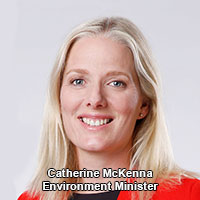
McKenna's town hall, Wednesday May 25th at 7 p.m. in the Canad Inns Fort Garry on Pembina Highway, was part of the townhall process for Canada's participation in the Paris Accord and to hear Canadian's advice. Terry Duguid, Liberal MP for Winnipeg South, hosted the event. Prime Minister Justin Trudeau formally added Canada's signature to the Paris Accord in April but most environmental commentators have said fulfilling it will the be hard part. Canada's nowhere near meeting targets to cut Canada's greenhouse emissions by 30 per cent let alone for 1.5degress Celsius ceiling on warming. The townhall in Winnipeg was packed and pretty much standing room only in the cramped dining room on the basement of the Canad Inns Fort Garry. So many people showed up that the stairs and antechamber leading outside the doors of the townhall were jammed with people. 350.org had bussed in 40 people.to the event. Among the crowd were unions and representative from many environmental groups as well as First Nations and Metis leaders. Several NDP MLAs made and appearance, including Wab Kinew, no Manitoba PCs appreared to be in attendace. The Green Party of Manitoba was there in force with Green Party leader James Beddome, Dave Nickarz, Signe Knutson and Kelly Whelan-Enns among others attending. It is unclear whether Minister McKenna understood that what she was witnessing was an educated public who understood there was far more to dealing with climate change than her power point presentation suggested. Minister McKenna, in her closing remarks after 30 tables provided recommendations, told the diverse crowd of Winnipegers her mind was blown. She congratulated everyone for the passion and ideas.
View May 27, 2016 Winnipeg Free Press article |
|
|
Print version |
Top |
| Canadian Environment Commissioner's Report 2016 | 27 May 16 |

The report summarizes the issues raised by Canadians in the 15 environmental petitions that were received between 1 July 2014 and 30 June 2015 and were forwarded to federal departments and agencies for response. Key issues included the transport of hazardous substances and environmental and human health. The purpose of this annual report is to inform Parliament and Canadians about the number, nature, and status of petitions and responses received between 1 July 2014 and 30 June 2015, as required by section 23 of the Auditor General Act. The environmental petitions process remains a unique way for Canadian residents to bring their concerns and questions about environmental issues to the attention of the federal ministers responsible and to obtain responses from them. The Commissioner of the Environment and Sustainable Development administers the environmental petitions process on behalf of the Auditor General. In addition to monitoring and reporting, the Commissioner posts summaries of the environmental petitions received and responses given on the Office of the Auditor General of Canada's website, and carries out outreach activities. Watch for her report May 31, 2016.
View 2015 Fall Reports of the Commissioner of the Environment and Sustainable Development |
|
|
Print version |
Top |
| Plants Face Extinction – New Reports | 16 May 16 |
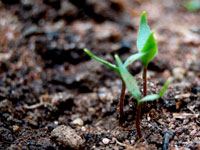
The report by Royal Botanic Gardens at Kew in England has provided the first comprehensive assessment of the world's plants. That assessment concluded that, excluding algae, mosses, liverworts and hornworts, there are approximately 390,900 plant species known to science, of which an estimated 369,000 are flowering plants. Compiled by a team of more than 80 scientists, this 84-page report is the most complete evaluation of the world's plants ever carried out. Due to be updated every year, the publication of the State of the World's Plants report coincided with a scientific symposium on 11 and 12 May at the Botanical Gardens in the London suburbs. Despite 21 per cent of all the species being threatened with extinction, the report also said new plants were still being discovered, such as a 1.5 metre (5 feet) tall insect-eating plant on a mountaintop in Brazil in 2015. "There's a huge change going on, mainly agricultural change and land for urbanization," said Kathy Willis, RBG Kew's director of science. Willis said a rising world population of more than 7 billion people need food and places to live and that scientists should be pragmatic and help identify areas most in need of conservation.
View May 12, 2016 EurActiv.com article |
|
|
Print version |
Top |
| Pallister Contradicts Election Promise About Bipole III | 16 May 16 |

The Pallister government has already broken this trust by choosing to let Manitoba Hydro's own board review Manitoba Hydro's massive Bipole III transmission line, not the Public Utilities Board as promised by the Progressive Conservatives. The PUB review of Bipole III was one of the promises Pallister made in their "first 100 days of change for a better Manitoba," campaign in the recent provincial election. As Manitoba Hydro reports it, the $4.5 billion dollar Bipole III is nearly half complete. Manitoba Hydro says it is needed to add security and reliability to power transmission in the province and to increase capacity from northern hydro dams. This mantra of needing Bipole III for security is not entirely true as investing the same amount of money in renewables like solar and wind would support a far safer de-centralised power grid. A de-centralised power grid would be almost immune to ice storms and climate events, and renewables are the best way a Manitoba government can keep its promise to First Nations and rate payers for a strong energy economy and long term jobs. Not having a PUB review of Bipole III also keeps the decision making process in the hands of Manitoba Hydro and cuts out any public participation in such an important review. The Manitoba Clean Environment Commission held hearings to review Bipole III. The environmental license for Bipole III is more extensive than for any other transmission project in the province. Bipole III was left out of the PUB review.
View May 12, 2016 CBC News article |
|
|
Print version |
Top |
| Big Oil Abandons Arctic Drilling | 16 May 16 |
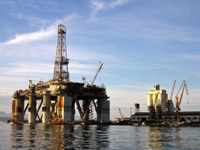
Crude oil prices have fallen to less than half of where they were in June 2014, forcing oil companies to cut spending. Shell and ConocoPhillips, decided to formally abandon arctic land claims before a May 1 due date to pay the U.S. government millions of dollars in rent to keep holdings in the Chukchi Sea north of Alaska. The U.S. Arctic is estimated to hold 27 billion barrels of oil and 132 trillion cubic feet of natural gas, but energy companies have struggled to tap resources buried below icy waters at the top of the globe. Big oil companies have relinquished 2.2 million acres of drilling rights in the Chukchi Sea -- nearly 80 percent of the leases they bought from the U.S. government in a 2008 auction. Oil companies spent more than $2.6 billion buying up 2.8 million acres in the Chukchi Sea during the 2008 sale. This after spending millions on exploration claims in the Beaufort Sea. The high costs of working in the Arctic means it is generally attractive only to large oil companies.
View May 9, 2016 Bloomberg article |
|
|
Print version |
Top |
| Mourning for Fort Mac | 7 May 16 |

I mourn for Fort Mac. The stories and the images coming out of northern Alberta are devastating and scary. I can’t imagine what the people of Fort McMurray and the surrounding areas are going through, and everything they will continue to go through as they try to recover and rebuild homes, businesses, and communities they loved. I mourn for them. Over the last couple of days, there are many others I have been thinking about, people that I had the honour and privilege of visiting, and the good fortune to be able to head back to my safe and secure home in Canada. I remember the Maasai people, living in southern Kenya in the shadow of Mount Kilimanjaro. They have lived a semi-nomadic life for centuries, moving season by season to find places for their cattle to graze and drink. When I visited them, despite all the collective, cultural knowledge held in their communities, their cattle were dying because they could not find enough food and water for them. No elder I spoke with had seen the land so altered as by the ongoing drought. The Kenyan government, in desperation, sent mechanical diggers throughout the region to dig down until they hit groundwater. Some of these pits, where water used to be available at the surface, were 20 or 30 feet deep. I mourn for them. Read the rest of this column here: |
|
|
Print version |
Top |
| Fort McMurray Burns in Climate Change Casino | 7 May 16 |
High winds and parched timber and brush from a spring heat wave stoked flames, which have engulfed 247,000 acres (101,000 hectares) in Canada's energy heartland since erupting May 2nd. Some 88,000 people were forced to flee Fort McMurray two days later. About a third of Canada's oil production has been shut due to wildfire storm, according to a Reuters estimate. Canada's northern forests have been burning more frequently over recent decades as temperatures there are rising at twice the rate of the global average. A 2013 analysis showed that the boreal forests of Alaska and northern Canada are now burning at a rate unseen in at least the past 10,000 years. The extreme weather of recent months is also closely linked with the ongoing record-setting El Niño conditions in the Pacific Ocean, which tends to bring a warmer and drier winter to this part of Canada. Last month, Canadian officials mentioned the possibility of "large fires" after over-winter snowpack was 60 to 85 percent below normal and drought conditions worsened. In 2012 a panel of experts issued a report that warned that the aging forests in Alberta were at great risk of 'catastrophic' wildfires. The Flat Top Complex report, named after the three fires which devastated Slave Lake in 2011, found that Alberta's forests were aging due to reduced wildfire activity that challenged ecosystems and increased the risk "of large and potentially catastrophic wildfires."
View May 7, 2016 Reuters article |
|
|
Print version |
Top |
| Fort McMurray Wildfire A Climate Event: May | 7 May 16 |
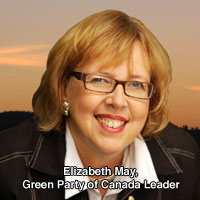
"Scientists will say we know with a destabilized climate, with a higher average global temperature, we will see more frequent, more extreme weather events ... due to an erratic climate, due to our addiction to fossil fuels." May later issued a statement to clarify her position. Climate change scientists have predicted that the planet will continue to experience an increase in extreme weather events because of a rising concentration of greenhouse gases in the atmosphere from the burning of fossil fuels. The Trudeau government was advised when it was sworn in last November that wildfires were getting worse. The bureaucrats at Natural Resources Canada told their new minister, Jim Carr, that governments across the country hadn't provided enough funding to help communities prepare for the worst.
View May 6, 2016 Toronto Star article |
|
|
Print version |
Top |
| Manitoba Protected Areas Audit Released During Election | 15 April 16 |

There is a discrepancy between Manitoba government data for the protected lands that shows 12% versus Manitoba Wildlands' data at 9.9%. Regulations for protection from mining are missing for some designations as of December 31,2015. "We have spent much of the winter identifying gaps in the regulatory system for protected areas, with the aim of urging government departments to complete the steps needed for protected areas already announced. Often it is the Mines Act regulation that is missing. As of April 13 some of these regulations are still outstanding. Included in the missing regulations are the First Nations traditional lands planning areas for the future World Heritage Site. The tracking chart shows NO in the column regarding protection from mining. Manitoba needs to return to its former rigor and professionalism regarding the scientific, consultative, and regulatory steps for protected areas establishment," indicated Gaile Whelan Enns, director of Manitoba Wildlands. View more information on Manitoba Wildlands Protected Areas Grades & Audit page |
|
|
Print version |
Top |
| Opposition To Fracking Growing | 10 April 16 |
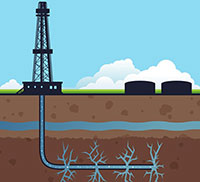
Concerns about this practice have riled the U.S. political landscape and communities around the country, perhaps nowhere more so than in Pavillion, Wyoming, population 231. As part of the so-called frackwater they inject into the ground, drilling companies use proprietary blends that can include potentially dangerous chemicals such as benzene and xylene. When the wastewater comes back up after use, it often includes those and a range of potentially dangerous natural chemicals. "Decades of activities at Pavillion put people at risk. These are not best practices for most drillers," said co-authorRob Jackson, the Michelle and Kevin Douglas Professor at the School of Earth, Energy & Environmental Sciences. A new study of the effects of fracking in Canada, “Hydraulic Fracturing and Seismicity in the Western Canada Sedimentary Basin” confirms the horizontal drilling technique (which in essence creates an underground mini-earthquake to open up fissures for oil and gas extraction) is responsible for earthquakes in western Canada, above and beyond what is already canonized in the scientific literature. Injecting fracking waste into underground wells can cause quakes. Now it's not just injections wells, but the fracking procedure itself being linked to seismic activity. Polls in both Canada and the U.S. show a steady growth in opposition to fracking and the risks to drinking water it poses. Add the fact that fracking caused earthquakes are now common place and you have a very sound argument to end fracking.
View April 4, 2016 DeSmogBlog article |
|
|
Print version |
Top |
| Seven Year Old Sues Pakistan Over Climate Change | 10 April 16 |

"The protection of these inalienable and fundamental rights is essential if we are to have any chance of leaving our children and future generations with a stable climate system and environment capable of sustaining human life," said Qazi Ali Athar, public interest environmental attorney representing his daughter as youth petitioner in the case. "Pakistan is rich in renewable energy resources such as solar and wind, more than enough to meet the energy needs of current and future generations of Pakistanis. Yet the federal and provincial governments of Pakistan, along with the vested interests in the country and the region, are exploiting Pakistan's most environmentally degrading and carbon intensive fuels—low-grade coal from the Thar Coal Reserves—in violation of the Pakistani people's constitutionally protected fundamental rights." The case is the latest in a global string of lawsuits geared at forcing governments to do more on climate change. It follows a landmark win in the Netherlands last year, where the government was forced to increase emissions reductions targets.
View April 8, 2016 New Matilda article |
|
|
Print version |
Top |
